1. Define the storefront
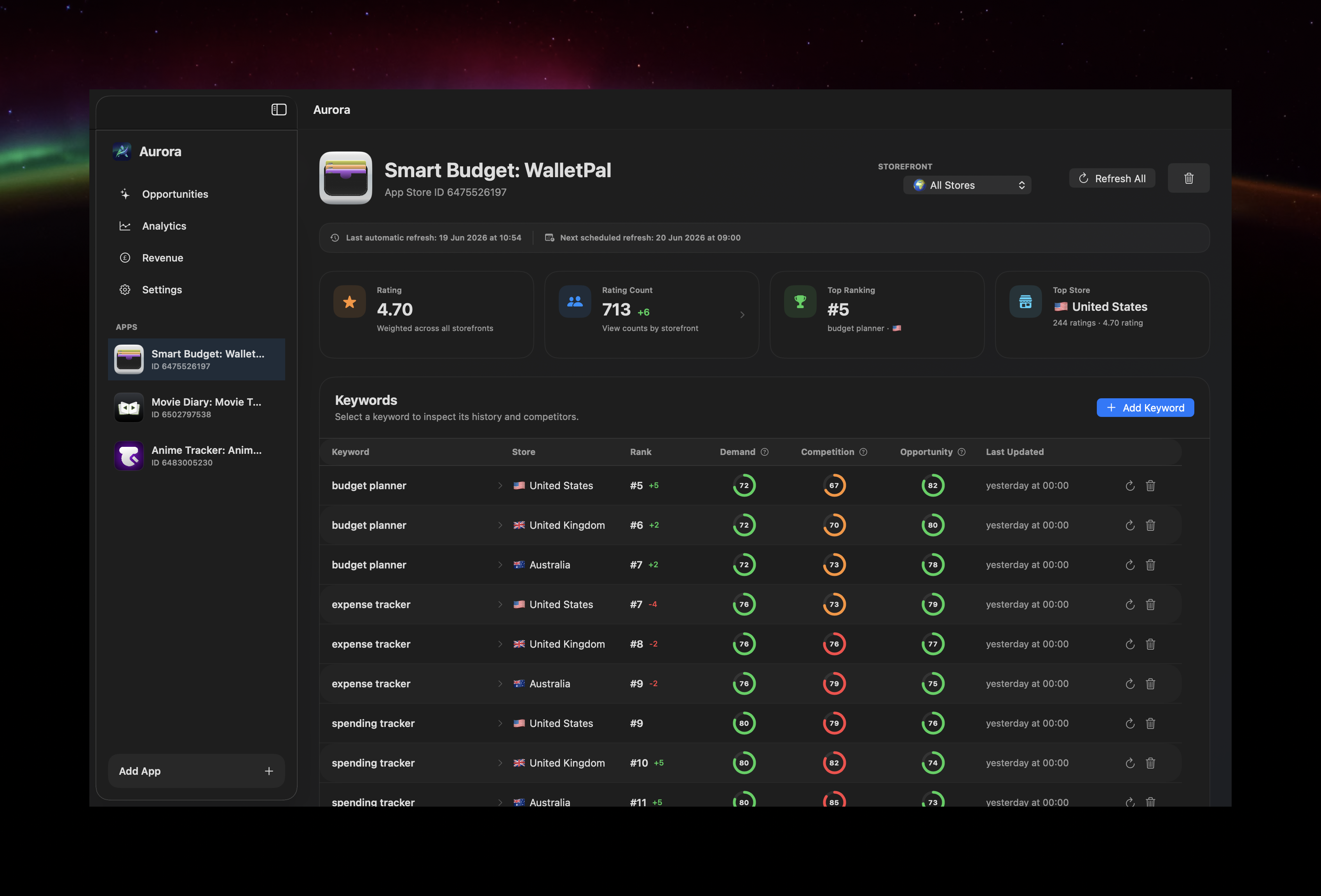
App Store search results differ by country. “Budget planner” in the United States and United Kingdom are separate observations, even when the app metadata is similar. Track the storefronts where you have meaningful localisation, downloads or commercial intent.
2. Start with a focused keyword set
Ten relevant phrases provide more signal than one hundred loosely related terms. Include a mix of direct category phrases, feature-led terms and realistic long-tail opportunities. Avoid competitor trademarks and terms that do not accurately describe the app.
3. Record positions consistently
Search results move. Check on a repeatable schedule and preserve history rather than judging a single snapshot. Aurora tracks positions from the Mac and plots ranking history, but the principle is the same in a spreadsheet: record the date, storefront, keyword and position.
4. Separate signal from noise
A one-position move is rarely enough to justify a metadata change. Look for sustained movement across several checks, movement across related keywords, or a change that follows a release, localisation or metadata update.
Branded searches and low-volume phrases can also behave differently from competitive category terms. Keep notes so you can distinguish an intentional experiment from an unexplained fluctuation.
5. Inspect the result set
Position alone does not explain why a keyword behaves as it does. Review the top apps: are their titles and subtitles semantically coherent with the query? Are major category leaders present? Is your app competing against close substitutes or unrelated results?
Aurora's top-20 and Competitor Watch views provide this context, but manual inspection remains valuable.
6. Connect visibility with performance
A higher rank is useful only if the term reaches the right audience. Compare ranking changes with App Store impressions, product page views, first-time downloads and conversion. If visibility improves while conversion falls, the phrase or product-page promise may be attracting the wrong visitors.
7. Review monthly
Keep strong, relevant terms; investigate declining clusters; retire phrases that remain irrelevant or unattainable; and add a small number of new opportunities. A measured monthly review is usually more useful than daily metadata changes.
Common mistakes
- Treating different storefronts as one market.
- Assuming a third-party demand score is exact search volume.
- Changing metadata after one ranking movement.
- Tracking terms without connecting them to downloads or conversion.
- Prioritising popularity over relevance.
Next: learn how to build the keyword shortlist or explore Aurora's rank-tracking features.