Begin with the product, not a tool
Write down the app's category, core job, strongest feature, target user and meaningful alternatives. Turn each into plain phrases a customer might type. A budgeting app might begin with “budget planner”, “expense tracker”, “spending tracker” and more specific feature-led terms.
Build seed groups
Group seeds by intent rather than collecting one long list:
- Category: the type of product.
- Problem: the outcome or frustration being solved.
- Feature: a concrete capability.
- Audience: who the product serves.
- Use case: when or why it is used.
Inspect real results
Search each term in the target storefront. A coherent top result set is evidence that the App Store associates the phrase with a recognisable need. If results are scattered across unrelated categories, a numerical popularity score alone should not convince you.
Note repeated language in titles and subtitles, but do not copy competitor trademarks. Apple advises developers to choose relevant, specific keywords and avoid competing app names.
Expand carefully
Use repeated words, adjacent phrases and feature combinations to form related candidates. Aurora's Keyword Explorer automates part of this process by examining observable result relationships, but every suggestion still needs a relevance check.
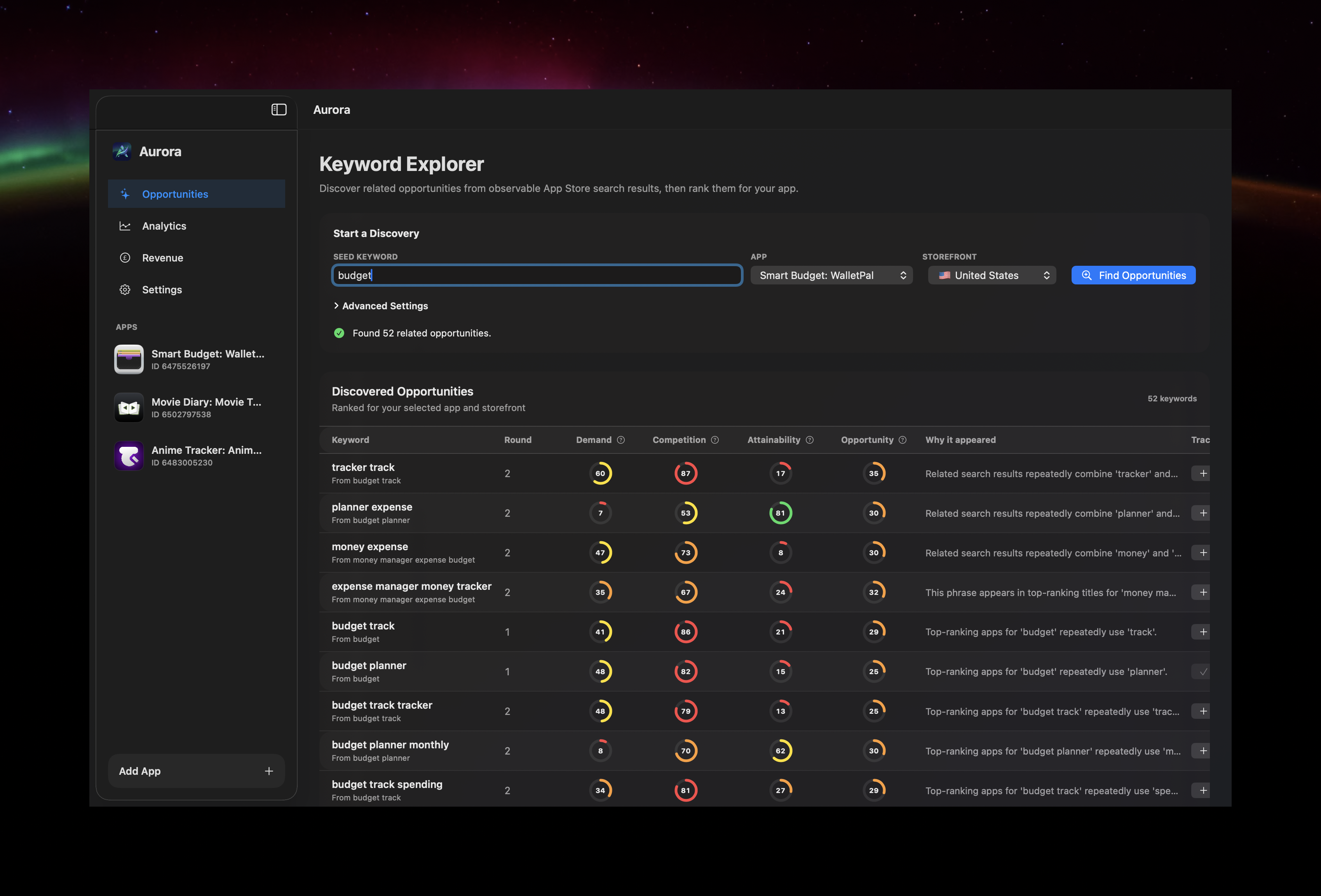
Assess four dimensions
| Dimension | Question |
|---|---|
| Relevance | Would someone searching this phrase be satisfied by the app? |
| Demand | Is there observable evidence that the phrase has meaningful interest? |
| Competition | How established and closely matched are the apps already ranking? |
| Attainability | Does your app have enough semantic and product evidence to compete? |
Third-party demand scores are directional. Apple does not publish exact organic search volume for every App Store keyword. Use the scores to compare candidates inside the same methodology, not as literal monthly search counts.
Prioritise a balanced shortlist
Select a mixture of core terms and narrower opportunities. Very broad phrases may offer demand but little attainability; extremely specific phrases may be attainable but commercially unimportant. A useful shortlist contains terms you can explain, monitor and support honestly in the product page.
Measure after publishing
Record metadata changes, track positions by storefront and compare visibility with impressions, page views, downloads and conversion after the reporting window completes. Keep terms that produce relevant visibility. Replace weak terms gradually so you can learn from each iteration.
Common mistakes
- Optimising for a score instead of user intent.
- Combining results from different countries.
- Using irrelevant or protected competitor terms.
- Changing too many metadata elements at once.
- Assuming rank improvement guarantees conversion.
Primary reference: Apple's product page and keyword guidance.
Continue with the Mac rank-tracking workflow or try the free ASO stack.